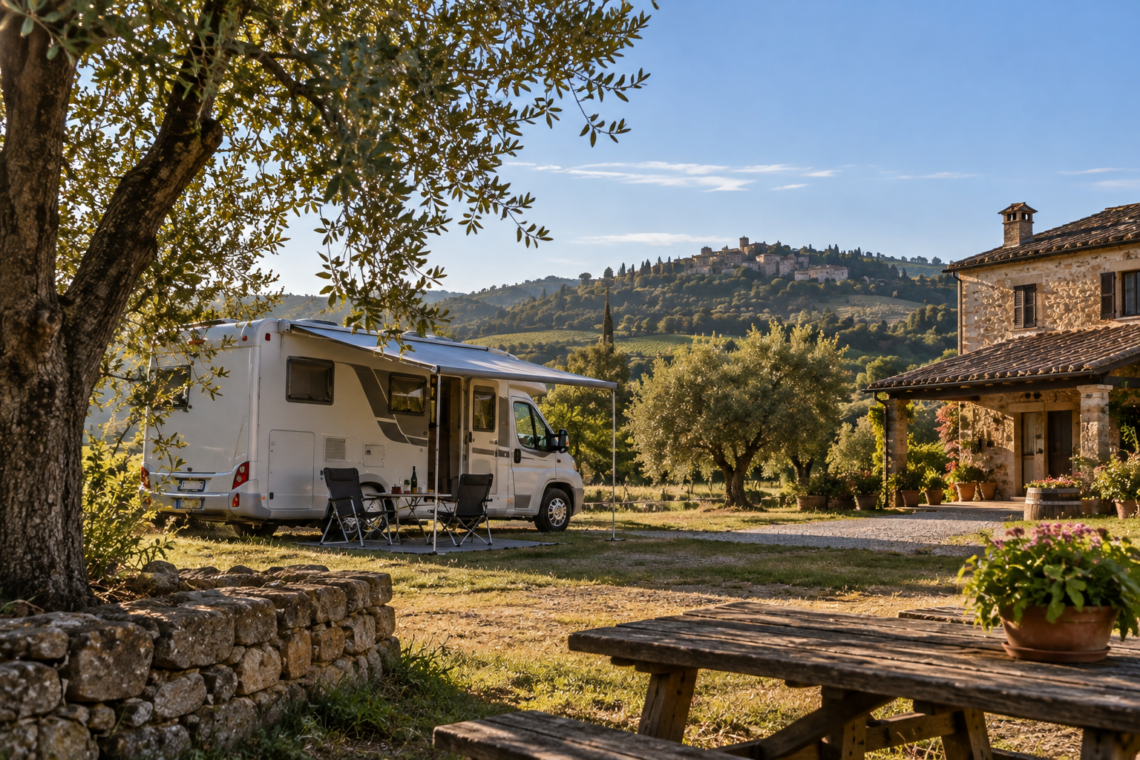
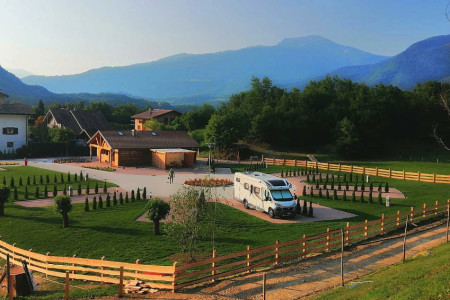
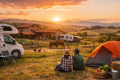
An agricampeggio is a farm camping offering outdoor accommodation as part of an Italian agritourism business. To open one, you need to meet three essential requirements: qualify as an agricultural entrepreneur, comply with the regulations of your Italian Region, and submit the required application to the municipality’s SUAP business office, often through a SCIA notification. Simply owning agricultural land is not enough. Pitch numbers, facilities and administrative procedures vary from one Region to another.
Before investing in construction work and permits, however, it makes sense to find out whether motorhome travellers will actually come. Through a free overnight stopover network such as Agricamper, your farm can welcome its first motorhome visitors for 24-hour stopovers and discover whether the area attracts travellers, without building anything. Registration is free for farms.
First question: do you want to welcome motorhome travellers or open a camping?
Before deciding how many pitches to create, it is worth clarifying your goal. If you want to establish a rural hospitality business with dedicated pitches, facilities and stays lasting several nights, opening an agricampeggio is the appropriate route. The rest of this guide explains how to proceed.
But if you have never welcomed motorhome travellers and simply want to find out whether this type of visitor is right for your farm, investing immediately in infrastructure could be premature.
Get to know motorhome travellers with Agricamper
Agricamper is a network bringing together hundreds of Italian farms. Participating farms provide space for free 24-hour stopovers for self-contained vehicles equipped with an onboard toilet, with a maximum of five vehicles at a time. The farm does not provide camping facilities or designated pitches and receives no payment from the traveller. Vehicles remain parked as ordinary vehicles, without any camping equipment set up outside.
For anyone considering opening a farm camping, this is a practical way to gather valuable information before investing. You can discover who visits your farm (couples, families, campervan owners or travellers with larger motorhomes), which months are busiest, what visitors are looking for (tastings, local produce or peace and quiet), and whether your entrance, turning space and ground conditions are suitable for their vehicles.
Most importantly, you will learn whether your area attracts consistent demand or only occasional visitors. Meanwhile, stopovers bring potential customers directly to your farm. Purchases are never compulsory, but the vast majority of motorhome travellers visit the farm and buy its products. It is a mutually beneficial arrangement.
Agricamper is neither a farm camping nor a tourist accommodation business. Its stopovers do not include equipped pitches, campsite services or extended stays. If you later decide to offer multi-night accommodation or pitches with facilities, you will need to follow the farm campsite regulations explained in this guide.
Register your farm with Agricamper for free. Welcome your first motorhome travellers, discover whether your area attracts touring visitors, and use real experience to decide whether investing in a farm camping makes sense.
Become an Agricamper host
What is an agricampeggio and who can open one?
Italian Law No. 96 of 20 February 2006 includes accommodation “in buildings or outdoor spaces intended for campers” among recognised agritourism activities, provided these are operated by an agricultural entrepreneur in connection with farming, forestry or livestock breeding.
This connection to an active agricultural business is what distinguishes an agricampeggio from a traditional camping, which falls under regional tourism legislation, and from a motorhome stopover area, whose legal classification varies between Regions.
Only an agricultural entrepreneur, as defined by Article 2135 of the Italian Civil Code, can therefore open an agricampeggio. This includes individuals or businesses engaged in crop cultivation, forestry, livestock breeding and related agricultural activities.
Farming must also remain the predominant activity compared with hospitality, and each Region determines how this balance is assessed. In Emilia-Romagna, for example, the number of working days devoted to agriculture must exceed the estimated number devoted to agritourism.
Regional laws make all the difference
Italy does not have a single nationwide set of operating rules for farm camping. Each Region establishes its own limits on pitches, guests, site dimensions and facilities. A project that complies with the rules in Toscana may not meet the requirements in Veneto or Emilia-Romagna.
The following table compares five Italian Regions as examples.
| Region |
Relevant legislation |
Requirements for outdoor accommodation |
| Emilia-Romagna |
Regional Law 4/2009 |
Up to 8 pitches, increasing to 15 in national parks, protected areas, Natura 2000 sites and mountain areas specified by law. Equipped pitches without permanent structures. |
| Lombardia |
Regional Law 31/2008 |
Accommodation in buildings and outdoor spaces for a combined maximum of 100 guests per day, subject to the required connection with agricultural activities. Pitches must have electricity connections and sanitary facilities, preferably located in existing buildings. |
| Piemonte |
Regional Law 1/2019 and Regulation 5/2023 |
The minimum pitch area has been increased to 60 m². |
| Toscana |
Regional Law 30/2003 and implementing regulations |
Farm camping limits of up to 35 pitches and 90 guests, depending on the farm’s circumstances. |
| Veneto |
Regional agritourism regulations |
A maximum of 30 pitches and 45 people per business, with specific minimum facility requirements for farm campings. |
These regional rules are supplemented by planning, building, landscape protection, environmental and public health regulations, as well as municipal requirements.
That is why your first practical point of contact should be the SUAP (Sportello Unico per le Attività Produttive), the one-stop business administration office of the municipality where your farm is located.
Pitches, sanitary facilities and capacity
Before designing the camping layout, ask a qualified professional to check pitch sizes and spacing, access routes and internal roads.
Next, assess the infrastructure: water supply, electricity where required, toilets and showers, wastewater disposal, waste management, lighting and safety.
Also check whether your Region applies different requirements to tents, caravans and motorhomes.
How to open a farm camping: step by step
The exact administrative process depends on the Region, municipality and proposed project, but the main steps are as follows.
- Check your agricultural eligibility: confirm your status as an agricultural entrepreneur and the required relationship between farming and hospitality activities under regional law.
- Review regional legislation: examine the agritourism law and its implementing regulations, particularly the sections covering outdoor accommodation.
- Check planning rules and restrictions: verify permitted land use, local planning requirements and any landscape or environmental restrictions.
- Consult the municipality and SUAP before spending money: bring a description of your farm, a site plan and an outline of the proposed pitches and facilities.
- Develop the project with a qualified professional and identify the required authorisations: these may concern construction, landscape protection, environmental matters or public health, depending on the work involved.
- Submit the SCIA or other required application to the SUAP: in Toscana, for example, the regional forms updated in 2025 provide for a SCIA notification for agritourism activities.
- Complete all other obligations before opening: these include tax, statistical reporting, health and public security requirements, such as guest registration and reporting.
How much does it cost to open a farm camping?
There is no reliable national average for the cost of opening an agricampeggio in Italy. A farm that already has suitable access roads, toilets and utility connections starts from a very different position from one that needs to build everything from scratch.
The most expensive elements are often those that visitors never notice: ground preparation and drainage, water supply, wastewater systems, electrical installations and improvements to access routes.
Other expenses include professional design services, administrative applications (SUAP fees vary between municipalities), sanitary facilities and pitches, followed by ongoing operating costs such as insurance, booking management, marketing and maintenance.
Request quotations based on a project that has already been reviewed with the municipality, rather than relying on a generic budget found online.
The most common mistakes
The most expensive mistake is building before checking both legal requirements and market demand. Non-compliant pitches may need to be rebuilt, while pitches that nobody books will never recover their investment.
The maximum number of pitches permitted by law is not necessarily the right number for your farm.
One of the most underestimated issues is vehicle access. An entrance that works perfectly for a car may be unsuitable for a seven-metre motorhome. Narrow gates, tight bends, low branches, steep slopes and soft ground can all become serious problems from the very first arrival.
After opening: help travellers find your farm camping
Opening a fully compliant agricampeggio is only half the job. The other half is making it visible to people travelling with tents, campervans, motorhomes or caravans.
Travellers looking for authentic rural camping experiences do not necessarily use the same booking channels as guests at large holiday parks. Without the right visibility, a small farm campsite can easily go unnoticed.
That is exactly why Natura Camping was created. This platform brings together different types of rural campsites across Italy, from farm camping and glamping sites to agricultural motorhome stopover areas, from the north to the south of the country.
Listing your campsite means presenting it to travellers who are specifically looking for what you offer: nature, farm products and a more personal welcome than a conventional holiday resort.
For a farm considering an agricampeggio, the journey can therefore follow three stages: first, get to know motorhome travellers through Agricamper’s free stopovers; next, open a farm campsite if demand justifies the investment; and finally, promote it through Natura Camping.
The two models can also operate alongside each other. A farm can remain part of the Agricamper network, offering its free 24-hour stopovers, while providing longer stays on its separate farm campsite pitches.
Already running a farm campsite or agricultural motorhome stopover area? List your property on Natura Camping and reach travellers searching for rural camping experiences in Italy.
List your farm campsite
Frequently asked questions about opening a farm campsite
Do I need to be an agricultural entrepreneur to open an agricampeggio?
Yes. Italian Law 96/2006 reserves agritourism activities, including farm campsites, for agricultural entrepreneurs as defined by Article 2135 of the Italian Civil Code. Simply owning agricultural land is not enough.
How many pitches can an agricampeggio have?
It depends on the Region. Limits range from 8 pitches in Emilia-Romagna (15 in protected and mountain areas) to 30 in Veneto and 35 in Toscana.
Are toilets and showers compulsory?
Requirements depend on the Region and type of accommodation. In Lombardia, for example, equipped pitches require sanitary facilities and an electricity connection.
What permits are required to open a farm campsite?
The process generally involves planning checks, any necessary building or landscape authorisations, and the required business commencement procedure, often a SCIA submitted to the municipality’s SUAP office.
How much does it cost to start a farm campsite?
There is no universal figure. Costs depend mainly on the infrastructure required, including vehicle access, water supply, electricity, wastewater disposal and sanitary facilities.
What is the difference between Agricamper and an agricampeggio?
An agricampeggio is a regulated accommodation business offering pitches, facilities and overnight stays under regional legislation. Agricamper is a network offering free 24-hour stopovers for self-contained vehicles, without campsite services or payment to the host, and is therefore not an accommodation business.
For anyone considering opening a farm campsite, Agricamper also offers a way to understand the motorhome travel market before making an investment.
How can I promote my farm campsite after opening?
By listing it on a dedicated rural camping platform such as Natura Camping, which brings together farm campsites, glamping sites and agricultural stopover areas throughout Italy.
Check first, invest later
Research first and invest later: that is the principle that can help you avoid unnecessary expenses.
If you are not yet sure whether motorhome travellers are the right audience for your farm, start by welcoming a few overnight visitors. If you already operate a campsite, the next step is to make sure travellers looking for your type of accommodation can find it.
This guide is for informational purposes only and does not replace professional legal, administrative, tax or technical advice.
Updated October 2026

 by