Travel and sustainability: why choosing a farm camping stay is the right choice
-
 by Agricamper
- 30/03/2026
- Sustainable Travel
- 0
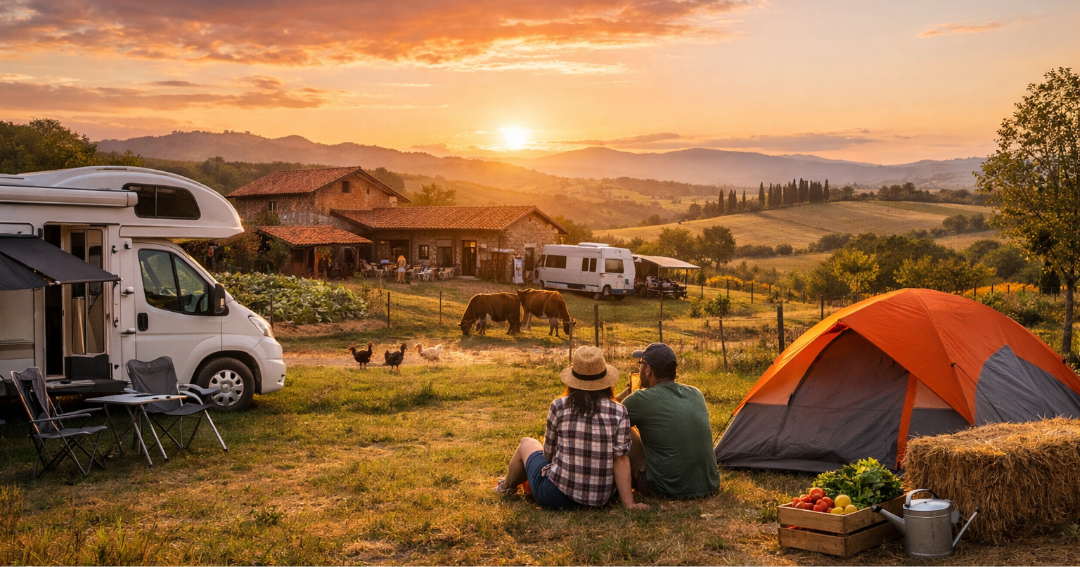
Travelling by motorhome, campervan, caravan or tent is often associated with freedom, nature and independence. But freedom alone does not make a journey sustainable. Today, more and more travellers are asking themselves an important question: how can we explore nature without damaging it?
The answer is not only about how we drive, what we consume or how often we move. It is also about where we choose to stop. The places we stay overnight, even for a short time, have a real environmental, social and economic impact.
This is where farm camping and rural stays come into play. Choosing farm camping is one of the most concrete ways to turn motorhome and tent travel into a truly sustainable, slow and responsible experience.
Whether you are travelling across Italy or simply close to home, the logic stays the same: sustainable travel starts with conscious stopping.
Why farm camping is a sustainable way to travel
Why is farm camping more sustainable than traditional camping?
Farm camping is more sustainable because it avoids intensive infrastructure and land transformation. Unlike large campsites, rural farm stays do not require concrete surfaces, permanent buildings or heavy utilities.
By using existing agricultural land in a controlled and limited way, farm camping reduces soil sealing and preserves natural landscapes. This approach aligns perfectly with sustainable travel and rural and sustainable camping.
How does staying on farms reduce environmental impact?
Staying on farms reduces environmental impact by decentralising tourism and lowering pressure on overcrowded areas.
Instead of concentrating hundreds of vehicles in one place, farm camping spreads travellers across rural territories.
This means less noise, less waste accumulation and lower stress on water and energy systems. Nature-based motorhome travel works best when density stays low and ecosystems can breathe.
How does farm camping encourage slow travel?
Farm camping naturally encourages slow travel by motorhome.
Rural stays are not about rushing from one attraction to another, but about stopping, observing and connecting with the place.
Travellers tend to stay longer, drive fewer kilometres per day and reduce fuel consumption. The journey becomes less about distance and more about experience, which is a key principle of eco-friendly travel.
How can travellers support local rural communities?
Travellers support rural communities by choosing stays that directly benefit local producers.
In farm camping, there is no intermediary extracting value from the territory.
This creates a positive economic loop where rural areas remain alive, agricultural activities are sustained and tourism becomes a complement, not a burden. Responsible travel is also about economic fairness.
Why is farm camping important for sustainable tourism in Italy?
Italy’s rural landscape is fragile and precious.
Farm camping helps protect it by promoting tourism that respects agricultural rhythms, seasonal cycles and biodiversity.
Instead of transforming the countryside into a tourist product, farm camping integrate travellers into existing rural life. This makes rural farm stays for campers a key element of sustainable tourism in Italy.
Sustainable travel in practice
Sustainable travel is not an abstract concept. It is made of daily choices and simple behaviours that, together, make a big difference.
Choosing farm camping and rural stays is one of the most effective actions, but it works best when combined with responsible habits.
Travelling slowly, planning fewer stops and respecting natural spaces reduces stress on both the environment and the traveller. Nature-based travel is about balance, not performance.
Waste management plays a central role. Reducing packaging, separating waste correctly and leaving places cleaner than you found them are essential practices. Farm camping often makes travellers more conscious of their impact because the environment feels personal, not anonymous.
Water and energy use should be limited and thoughtful. Motorhome, caravan and campervan travellers are already used to autonomy, which naturally encourages moderation and efficiency.
Respecting silence, agricultural work and private spaces is equally important. Rural stays are living environments, not tourist infrastructures. Understanding this difference is key to responsible tourism.
Finally, sustainable travel is also about attitude. Curiosity, respect and openness create positive interactions and make outdoor travel meaningful.
Conclusion
If you believe that travelling by motorhome or tent should also mean respecting nature, local communities and rural landscapes, farm camping is the right choice.
Discover and book sustainable rural stays and farm camping across Italy on Natura Camping, and turn your next road trip into a truly responsible outdoor experience.